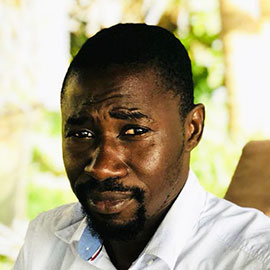
Sanna Manjang, a man described by Gambia’s truth commission as one of the two most feared members of the Junglers – a paramilitary death squad under the command of ex–president Yahya Jammeh – on January 15 pleaded not-guilty to a two–count murder charge before the country’s High Court.
Manjang was arrested in a joint operation of Gambian and Senegalese security forces in the jungles of Casamance, a southern part of Senegal. On December 3, he was charged with the 2004 killing of Deyda Hydara, a leading Gambian journalist, as well as the 2006 killings of a businessman named Ndongo Mboob and a cousin of Jammeh, Haruna Jammeh.
While the Gambian police started building those case files, Manjang was sent to Mile 2 Central Prison, awaiting a formal appearance before the High Court to take a plea.
Sudden change of prosecution strategy
But on January 15, state prosecutors introduced fresh charges, removing the murder of Hydara, Jammeh and Mboob, replacing them with the murder of two unknown persons, Kajali Jammeh and Samba Wurry, both of whom were allegedly killed by Manjang in Kanilai, South Gambia, in 2006.
Very little information about the two new victims in the Manjang case was gathered by the truth commission.
Kajali Jammeh was reportedly a rebel from Casamance and possibly a cannabis smuggler. He was found with a gun and detained for a few days in 2006. “[Sanna Manjang] told Kajali I will kill you, cut off your head and feed your remains to the crocodile. And that was what he did,” said witness Ensa Keita in March 2020 before the truth commission (TRRC). Ex-president Jammeh had several crocodile pools in his residence of Kanilai. Samba Wurry was a cattle rustler and was also allegedly executed in Kanilai by Manjang.
Two of the victims’ families — Deyda’s and Haruna’s — told Justice Info they had no prior notice from the State of the changes of plan, something they described as “disappointing”. These families said they were interviewed during the preparatory stages of the charges against Manjang for the alleged murder of their loved ones.
Deyda Hydara’s son Baba, who was in the court and not given prior information about the prosecution’s change of plan, said he was “enraged” by the unexpected changes. He later said he was satisfied, without saying more, with an explanation offered by an official from the Ministry of Justice.
The new charges are based on the sole testimony of Keita. A labourer in Kanilai, he ran into trouble with former president Jammeh and claimed while in custody to have witnessed the killing of Kajali Jammeh. In 2006, Keita said he got a contract to supply about 2,600 USD worth of gravel and sand for construction to Kanilai, the private residence of the president. But he wasn’t paid. His repeated insistence through several visits to the Jammeh residence would get him arrested, detained in Kanilai, and tortured for about a month.
No other Jungler corroborated these claims. Keita is listed in the new indictment as a state prosecution witness, with two investigators in the case.
Impromptu trial
Manjang’s arrest was preceded by an announcement of former president Jammeh vowing to return from exile in Equatorial Guinea. Although this is not the first time he has announced it, the suddenness of Manjang’s trial, only two months after his arrest in Senegal, appears to be linked to national security concerns. Authorities view Manjang, a staunch Jammeh loyalist, as a high-risk figure who cannot be allowed to walk free.
A Ministry of Justice official, speaking to Justice Info on condition of anonymity, admitted that these circumstances compelled the State to bring charges despite being largely unprepared. The prosecution reportedly opted for cases which rely on the testimony of a single witness as a temporary measure. A state prosecutor told also Justice Info that another option they are pursuing to secure his detention is persuading the army to court-martial Manjang on charges of desertion.
However, Manjang’s lawyer Sheriff Kumba Jobe told Justice Info that he intends to appeal the court’s ruling on the competency of the charges on grounds Manjang was charged under the Criminal Code, which was repealed by a New Criminal Offence Act.
Awaiting the special court
Sources close to the prosecution suggest the State is intentionally holding back the high-profile part of the charges, such as the Hydara murder, for the Special Hybrid Court. In December 2024, the Economic Community of West African States approved a partnership with the Gambia to set up this court, but it is still awaited.
The special court is looking for funding. According to a Gambian government spokesperson, a special prosecutor whose name is not yet public is expected to be appointed in February 2026. The Gambian government said it has set aside over one hundred thousand dollars for the most crucial operations of the office of the special prosecutor for one year. Without giving any further details about the timetable, it said the hybrid court would start once the prosecutor’s office has completed the investigative phase.
Many former Junglers, who could become defendants or witnesses, are reportedly holding out now for immunity deals, a power that currently rests solely with the special prosecutor.
Manjang is due back in court on February 9, when the State is expected to call its witness.