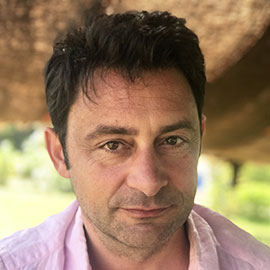
The funeral service for the prosecutor of the Special Criminal Court (CPS), who had died in his country of origin on March 25 “after a long illness”, took place without much fanfare last week-end in Kinshasa, Democratic Republic of the Congo.
After a highly publicized arrival on May 25, 2017 at Bangui-M’poko International Airport serving the Central African Republic’s capital, Congolese prosecutor Toussaint Muntazini Mukimapa quickly moved to a low profile, not just for strategic reasons. He was affected by a stroke and confided to Justice Info more than three years ago that he might step down. This was at the end of the CPS’s first five-year term, which has since been renewed for another five years.
The announcement of his death made his absence official. According to sources close to the court, he had not been physically present in Bangui since March 2025, and his ability to work had been significantly reduced for several years. The decision was made, however, not to launch a new recruitment process and to leave the court without a chief prosecutor. It was also decided not to make public his official resignation, which was received by the Central African government in mid-February 2026.
When contacted by Justice Info, the two oversight authorities of the hybrid court—the United Nations mission in the Central African Republic (MINUSCA) and the Central African Ministry of Justice—declined to comment on their decision not to launch a recruitment process for a new international prosecutor to succeed the Congolese military prosecutor.

Strict diet in Bangui
Like the International Criminal Court (ICC), the CPS is “headless” for at least a year. Consequently, it is Deputy Prosecutor Alain Ouaby-Bekaï who makes strategic decisions on prosecutions.
When interviewed by Justice Info, Court President Michel Landry Louanga described a situation that is not conducive to recruitment, noting that as of early April, the CPS still had “no clarity on its 2026 budget”. He said donors asked the court to reduce its staff by 25% in 2025, yet “apparently we are now being asked to do more”.
According to concurring sources, the court’s donors and supervisory bodies agree that the CPS will have to close its doors at the end of its second five-year term in November 2028. “There will be no funding beyond that, the message has been clear,” confides a judge speaking on condition of anonymity -- although according to the court’s statute, its mandate is renewable “if necessary”.
In contrast to the ICC, which saw its budget of nearly 200 million euros renewed at the end of 2025 without debate, austerity measures are in effect at the CPS. The United States, whose annual contribution previously amounted to $1.9 million, stopped supporting it in 2025. The contribution from the UN mission in the Central African Republic (MINUSCA), which was 5.6 million, remains unknown to this day. Only the return of the European Union in 2025, with a contribution of around 800,000 EUR per year for four years, allows the CPS to hope it can stay afloat, with an annual budget that will in 2026 certainly not reach the $7 million that was barely achieved on average in previous years. The CPS, whose operating budget is estimated at $14 million, has been structurally underfunded since its inception.
“This drastic reduction in funding has already profoundly affected the court’s operations and threatens its very existence, with serious repercussions on ongoing proceedings and services provided to victims and witnesses,” warned human rights organization Amnesty International in an alarming statement on February 11, 2026.
A busy end of mandate?
The court’s president, however, describes a potentially active, even hyperactive, final phase.
With three trials concluded, resulting in the conviction of 19 lower and mid-ranking militiamen (ten of whom were convicted in absentia), the CPS now boasts a more convincing track record than that of its older sister in The Hague, despite operating in a less than favourable political and security context. The ICC has, since the launch of its Central African investigations in 2007 (concluded after the arrival of Prosecutor Karim Khan in late 2022), secured the conviction of two mid-level defendants and suffered resounding failures, including the acquittal of Jean-Pierre Bemba and the abrupt halt of a trial involving a former minister.
The historically established division of labour between an international court to try the highest-ranking suspects and a hybrid tribunal responsible for mid-level perpetrators has not materialized here, and cooperation between the two jurisdictions culminated in 2025 in a months-long standoff ultimately won by Bangui. Edmond Beina, the anti-balaka militia leader sought insistently by an ICC struggling to hold trials, is currently on trial in Bangui alongside other defendants in the so-called “Guen” case, which is currently in its closing phase.
“A second case is currently before the criminal division,” court president Louanga told Justice Info. This is the so-called “Bossembélé” case, which plans to try former president François Bozize in absentia, along with defendants who will be present at the trial. Two other cases of symbolic importance to Central Africans have been referred to the criminal division by investigating judges: the so-called “Fatima” case and the “Alindao” case, which targets a currently serving minister, Hassan Bouba. A third case, known as the “Boyo” case, has been closed since March 12 and involves 16 “Black Russians” -- Central Africans who collaborated with the Russian armed group Wagner, active in the CAR since 2017.
Another investigation is still ongoing, concerning Abdoulaye Hissene, a “big fish” and former military leader of the FPRC armed group who was arrested on a CPS warrant in September 2023. He is currently in pre-trial detention in Bangui. At least seven other cases are reportedly currently under investigation and nearing completion.
Only one trial chamber
The CPS’s statute initially provided for three trial chambers composed of nine judges, but it must now make do with a single one. “What is provided by law is indeed to have three trial chambers,” says the court’s president. “With new cases coming in at the end of 2024 and beginning of 2025, we wrote to MINUSCA and the Ministry of Justice to request a second trial chamber. We were told there was no possibility, no money for that.”
“With just one chamber, it will be very difficult to try all these cases before the end of 2028. It’s practically impossible,” adds Louanga with resignation. “We won’t know until the very end, if we make it to 2028. We remain determined and hope we’ll find solutions, if only to see this mandate through to the end. That is my most heartfelt wish.”
The European Union has launched a project to digitize the archives and is already discussing the transfer of cases to ordinary Central African courts, as part of passing on the court’s legacy. But for now, Louanga notes, the CPS does not know its 2026 budget.
“Thanks to the combined contributions of MINUSCA and the European Union, the court’s funding is guaranteed until June 30, 2026. Beyond that date, we will need to find new funding,” MINUSCA spokesperson Florence Marshall told a press conference on February 18, while also acknowledging a liquidity crisis within the parent organization, the UN.