“No God please, my brother... no!”
A man screams as he clutches the upper half of a human body. People, their faces covered in blood, emerge from the rubble of a building reduced to ruins, while others dig through the debris in a desperate search for their loved ones.
“Massacre!” the cameraman shouts. “The regime bombed the al-Mleiha gas station with a MiG.”
The judge turns to the young court clerk sitting behind a laptop and asks her to stop the video. Silence falls over Courtroom Four at the Palace of Justice in Damascus. Beneath the wooden arch, under the large symbol of the scales of justice, Judge Fakhr al-Din al-Aryan looks up at the defendant, who is standing in the corner of the iron cage on the left side of the courtroom.
- How do you respond to the accusations that you formed auxiliary armed groups in Eastern Ghouta that shelled the area with mortars after Assad’s air force attacked it? This shelling contributed to the massacre that killed more than thirty people.
- I only introduced some people to Mohammad Zaour, my cousin’s son-in-law, the man inside the cage replies. I did not form any militias or personally lead them.
“May God never forgive whoever did this”
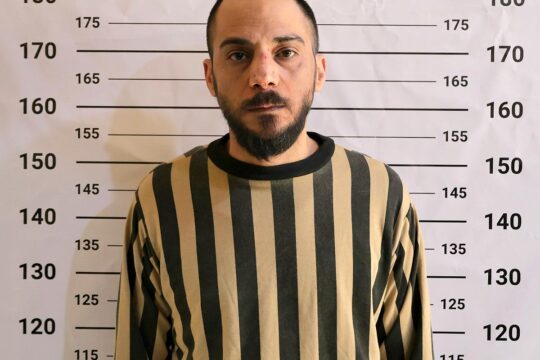
The man standing inside the cage is Wassim al-Assad, the first Assad family member facing a trial after the regime fell December 2024. The only undisputed fact about Wassim al-Assad is that he is a cousin of former Syrian president Bashar al-Assad. One of the main accusations against him is that he formed pro-government armed groups, known in the former Syrian system as “auxiliary forces” or local militias.
According to the indictment read out by the court, Wassim al-Assad is accused of forming and leading two armed groups [unidentified during the hearing], incitement to murder and violence, drug trafficking, exploiting his family ties for looting and extortion, receiving money in return for mediating with security and military agencies, and providing weapons, funding and logistical support to armed groups that fought in Eastern Ghouta (East of Damascus).
During the hearing, the court showed several videos that, according to the prosecution, it said linked groups associated with Wassim al-Assad to violent incidents. One of them occurred on 2 January 2013, when a gas station in the town of al-Mleiha in Eastern Ghouta, Damascus, was bombed. According to a report by the Syrian Network for Human Rights, about 70 civilians were killed in the airstrike and in an attack that followed by auxiliary forces supporting the Syrian army.
When one of these videos was shown, Wassim al-Assad said: “May God never forgive whoever did this.” He denied having any direct role in the al-Mleiha attack, saying that his role was only to introduce people to one another and that he did not take part in forming armed groups.
The court showed videos that had previously been published by Wassim al-Assad himself on social media between 2012 and 2024. In these videos, he spoke about taking part in military operations in several areas, including rural Damascus and Deir ez-Zor.

Questioned by the presiding judge, the former president’s cousin responded:
- It was all just talk. All Syrians posted videos like these. They were just talk, before adding, in a trembling voice: Why am I the only one being singled out?
The judge showed another video back from august 2023 in which the defendant boasts about his role, claiming that he and his groups were carrying out security operations near the border with Deir ez-Zor.
- Your Honour, I only ask you to look carefully at the date of this video! At that time, the situation in Deir ez-Zor was stable. There were no military operations at all, he told the court in a soft and calm voice, drawing quiet laughter from the courtroom.
In another image shown during the hearing, Wassim al-Assad appeared pointing a Kalashnikov rifle at a civilian lying on the ground in front of a car.
- The man in the photo is my friend. We were taking it as a joke. It’s obvious that the photo was taken on a farm!, he smiled.
Nouh Zaiter and Captagon
In 2023, the U.S. Department of the Treasury placed Wassim al-Assad under sanctions, accusing him of facilitating activities related to drug trafficking and the production of Captagon. In court, the defendant denied all accusations related to drug trafficking or any similar activities.
Looking down at his papers, the judge turned to the cage and asked:
- Do you know Nouh Zaiter?
- Yes, your Honour.
- Is there any need to show the photos of the two of you together?
- There is no need. I got to know Nouh Zaiter through Facebook. I met him once at the Sheraton Hotel in Damascus, and that was when we took our first photo. The second time we met was in Tartous.
The judge then asked whether they had ever had any business relationship. - Your Honour, if I had traded even a single cigarette with Nouh, it would have been impossible for you to find only one photo of us together!
Allegations of forming armed groups on the Syrian coast
During the hearing, Wassim al-Assad was also accused of forming armed groups to create unrest on the Syrian coast during the March 2025 episode of violence, and of receiving instructions from individuals outside Syria to finance and manage these groups through Zaiter.
- I received a phone call from Nouh Zaiter. He told me that someone on behalf of Wiam Wahhab would contact me shortly, Wassim al-Assad told the court. Two days later, a man called me and asked me what I was planning to do after the recent events on the Syrian coast, and whether I wanted to recruit and arm groups there. There was only one thing I could tell him: The eye cannot fight the awl. What you are thinking about is useless now. I told him that what Miqdad Fteha had done had brought nothing to the coast except bloodshed.
Wiam Wahhab is a Lebanese politician, leader of the Arab Unification Party, who has long been publicly aligned with the Assad government. Miqdad Fteha is a former commander of pro-government armed groups who emerged as one of the figures calling for armed resistance against Syria’s new authorities after the fall of Bashar al-Assad in December 2024.
“no lawyer has dared to defend me”
At this point in the hearing, the judge asked the court clerk to display the evidence brought by one claimant, whose identity is under court protection. Photos appeared on the screen showing the claimant with bruises covering his body, which he said were the result of torture.
- Do you know this man?, the judge asked Wassim al-Assad.
- The face is familiar. I may know him, but I don’t remember.
- You are accused of kidnapping this man together with members of your group, torturing him, and demanding a ransom in exchange for his release.
- Your Honour, today I stand before you under the authority of the law. I have nothing protecting me, and even no lawyer has dared to defend me. All I can say is that the burden of proof is on the one who made the claim, quietly articulated the man standing in a corner of the cage.
As the first hearing was dedicated to the sole questioning of the accused, the claimant was not asked to respond. He remained seated after the judge instructed him to do so.
Adjourning the hearing until Wednesday, 15 July 2026, the judge asked Wassim al-Assad if he had any final statement.
- I am a normal citizen. I worked in general trade. I sold cars, and I worked in import, export and customs clearance. Sometimes I looked for government tenders that could bring me some profit. But I was never involved in bloodshed. Yes, I took some photos, and I may have shown off a little. I apologies to the Syrian people for that.
- All I want, Your Honour, is justice. And if I deserve to be executed, then I accept that.
This publication was funded by the European Union under the project "Inclusive Justice in Syria: Building Capacity, Centering Victims". Its contents are the sole responsibility of Justice Info and do not necessarily reflect the views of the European Union. Justice Info’s journalists retain full editorial independence over all content.