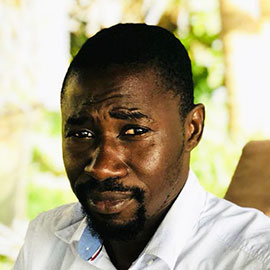
Sanna Manjang, one of Gambia’s most feared Junglers, a group of hitmen under the regime of Yahya Jammeh (1994-2017), was brought to court under heavy armed escort for the resumption of his trial in Banjul, on March 25. The court was packed, with a handful standing at the door— a large chunk of them sympathisers of the former Jungler. In cuffs, Manjang took his seat near the dock before the judge walked in. A man in navy blue soon joined him, sitting barely one and a half meters away. He is Tamsir Jasseh, a US army veteran who served under Jammeh as the director of immigration.
Jasseh represents a change in the prosecution strategy. His story, as serving soldier Yahya Darboe’s, has put away another Jungler, Michael Correa, in a trial that took place in the United States exactly a year ago. Gambian prosecutors, who’ve started a shaky case against Manjang, have now amended their chargesheet to include the two as their witnesses in the high-profile trial that began in January.
The Jungler was first charged with the killing of journalist Deyda Hydara, a cousin of ex–president Jammeh Haruna Jammeh and a businessman, Ndongo Mboob. These charges were removed and replaced with the killing of little-known Kajali Jammeh, reportedly a rebel from Casamance and possibly a cannabis smuggler, and cattle rustler Samba Wurry Bah.
Torture as “talk sessions”
Very little is known about both alleged victims, with no identifiable relatives, national documents or close contact other than Ensa Keita, who claimed to have seen the two being killed while he was in detention in Kanilai, the former dictator’s private residence, in 2006.
Keita was a labourer in Kanilai, when he reportedly ran into trouble with former president Jammeh. In 2006, he was contracted to supply about 2,600 US dollars worth of gravel and sand for construction to Kanilai. But he wasn’t paid. His repeated insistence through several visits to the Jammeh residence would get him arrested, detained in Kanilai, and tortured for about a month. However, no other Jungler corroborated Keita’s claims.
The two new charges added onto a two–count chargesheet are the torture in custody of Tamsir Jasseh and Yahya Darboe. Both were arrested in 2006 and accused of participating in the foiled coup led by late Col. Ndure Cham, whom Gambia’s truth commission confirmed to have been arrested by Junglers and killed in 2009. Manjang allegedly beat both Jasseh and Darboe with sticks, and melted hot plastic on Darboe, as he tied him with a sack and winched him up.
Following their arrest, Jasseh and his colleagues were taken to state central prison, Mile 2. At different times in the night, from 10pm to 3 am, he would be picked up by Junglers, among whom was reportedly Manjang, and taken to appear before a panel of investigators, at the National Intelligence Agency. “They kicked, punched and hit us with barrels of a gun until you entered into a waiting truck,” Jasseh told the court.
The investigation by the national truth commission, which sat between 2018 and 2021, has uncovered that such so–called panel investigations at NIA were always complemented with torture by Junglers, winning them the nickname of “talk sessions”.
“My recollection of what happened at the panel is fuzzy. Everyone was asking questions and usually they did not wait for answers,” said Jasseh. “You could hear screams. You could clearly understand that someone was going through pain.” Jasseh would eventually write a confession “against his will” that would be used to secure his sentence to a 20-year jail term of which he served 6 years before he was pardoned through the intervention of famous US civil rights advocate Jesse Jackson.
Jasseh could not tell who the head of the panel was. However, the panel members who extracted his forced confession, denying him a lawyer, “should see visible signs of torture on me,” he told the court.
“In the process of the investigations, the suspects were tortured to confess to the planned coup on national TV,” concluded the truth commission in its final report. “The footage was to also be used for the successful prosecution of the coupist.”
A victim’s tormenter now his boss
In 2021 Jasseh made a failed attempt to join the race to Gambian presidency. He now serves as an adviser to the Inspector General of the Gambian police. His task is to help him “modernise the force,” a task he has to execute with deputy police chief Demba Sowe.
And it appears that Sowe had served on the panel investigation at the NIA in times of dictatorship, as shown by the panel’s member list established by the truth commission.
Alongside Sowe, at least two other members of the panel are currently serving in various positions in the police while another member, former army chief Lang Tombong Tamba, serves as Gambia’s deputy ambassador to Russia.
While Gambia’s truth commission recommended certain individuals to be banned from holding public office, there were some accused of involvement in human rights abuse who were not recommended to be banned, or prosecuted. Sowe does not appear on the list of those recommended by the truth commission.
The Ban from Public Office Act, passed into law in 2023 and signed by Gambia’s president in 2024, targets public officials recommended to be banned. This process is still ongoing for a number of people despite a letter from the justice ministry asking concerned state institutions to implement the recommendations, according to the National Human Right Commission’s last monitoring report. In April, Gambia’s justice minister Dawda Jallow told reporters that they have not developed any policy to address any such tension as might arise from victims and alleged perpetrators working in the same institution.
Didier Gbery, Gambia's representative for the International Center for Transitional Justice, said a strong legal and institutional measure should be in place for proper vetting to ensure a safe working environment for victims. “Also, whistleblower policies should be in place in the administration to protect agents who witness and want to denounce violations. Another layer could be a victims protection law,” he said. “Public sector conditions of employment should require full disclosure of any past conduct that has a bearing on their employment. Failure to disclose material information, such as involvement in atrocities, should be grounds for summary dismissal.”