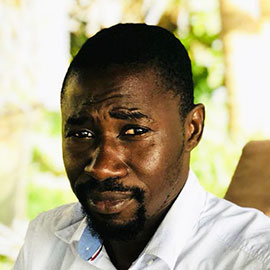
We first met Martin Hackett on May 8, before the start of a road trip organised both to meet and reassure the victims of the Yahya Jammeh era. The British lawyer just came from his sworn in ceremony as special prosecutor at the Gambia presidency, in a suit and tie.
Three days later, when the trip started on May 11, Martin rolled to his forearm a white-coloured long sleeve, wearing dark brown trousers and thin–framed, dark rectangular prescription glasses. His tone was serious and political, with carefully chosen words meant to reassure a disillusioned audience, while navigating a complex political environment.
For Hackett, this nationwide tour is assumed to be a charm offensive to win over the victim community that increasingly feels abandoned.
Bumps on the road to justice
But four days before his sworn in, the road for this man dropped in at the helm of a special court still in search of funds was paved with ironies.
On May 4th President Adama Barrow appointed Yankuba Sonko to chair the Local Government Commission – that oversees the administrative, financial, and strategic governance of the municipalities in the small Western African country. Sonko, a senior police officer under Jammeh’s regime later appointed interior minister by Adama Barrow, was recommended to be banned from public office for 10 years by the Truth Commission for his role in destroying evidence during and in the immediate aftermath of the 2005 massacre of over 50 West African migrants.
“Without transparency and accountability, this appointment represents a breach of public trust and a dismissal of victims’ efforts in pursuit of truth and justice. It is also a dangerous precedent that undermines accountability and a direct affront to the ‘Never Again’ commitment embraced by the Gambian people,” an alliance of victims-led organizations said in a statement.
Victims are already fatigued
A question remains unanswered: when Hackett took oath, did he know that just before him, an official accused of covering up of the killing of West Africa migrants was in a similar seat at the presidency, a metaphor of a political double–speak in Banjul?
A few hours after, he joined the members of the post-TRRC unit [that coordinates the implementation of the commission’s recommendations] at the Ministry of Justice to meet the victims at the Memory House. On the walls, staring at him, are pictures of pain, loss and decades–old weeping for justice; inside are displayed transparent glass cases holding thorn shirts of victims, and other memorabilia that speaks the story of people whose lives were cut short during the dictatorship.
An atmosphere that reminded Hackett of the burden on his shoulders.
Kebba Jome, a representative of the Victim Center—a conglomeration of all Jammeh–era victims who also joined later on this nationwide tour, set the tone: “The victims are already fatigued,” he started to tell Hackett. “The victims expected reparations before prosecution. Now, we are here and things are haphazardly being done. It is like reparations are going to take another five years to be completed. Right now, there is a lot of frustration. Once the people will receive reparation, the willingness will be there to testify or be interviewed for evidence.”
According to activists Sira Ndow and Imran Darboe, people do not understand why a whole new legal process is required when perpetrators already confessed on television during the Truth Commission. “The biggest blow will be having our first case thrown out on a technicality,” Ndow said in another address to the newcomer.
“The process cannot be rushed. The first case will not happen tomorrow… We want to get it right. For ourselves and for justice also,” Hackett answered the victim’s representatives.
“Everyone’s eyes are on him !”
On the first day of the trip, Hackett struck up a conversation with Gambia residents in a hall of Brikama, the administrative capital of the West Coast, about an hour drive from Banjul. The region was home to witch-hunting, one of the most striking crimes committed by the Jammeh regime: community elders were humiliated, dragged through the streets, called names, and forced to drink a deadly concoction that killed at least 41 people, according to the Truth Commission.
As the discussion winds to a close, an old man who sat on a front seat gets up. Wuyeh Sima is dressed in a casual traditional white robe, a scarf around his neck and prescription glasses which he reportedly uses after developing an eye problem due to an unconfirmed crime by the Jammeh regime. He never testified before the Truth Commission, but is now among an increasing group of victims who are hoping to be listed and recognised by the Reparation Commission.
- “Hey,” Sima beckons the translator, “tell him,” pointing at Hackett who sat barely two meters away, “in this country, everyone’s eyes are on him!”
- “As a prosecutor’s office, we have to be independent. I can assure you that my office will be independent,” answers Hackett.
A message he echoed at another meeting in Essau on May 12. Essau lies across the mouth of the Gambia River, about three miles north of the capital, Banjul. There, the reparation commission and Hackett’s caravan met with another group of victims and another community that was seriously affected by witch-hunting.
“I can assure you that as an individual, as a prosecutor, I am not going to be pressured from prosecuting one case or not another. I will make my decisions based on evidence”, he repeated.

Handling the politics of prosecution
The Gambia’s Truth Commission has recommended 69 individuals, including Jammeh, for prosecution. But effective prosecution is a long way away. The hybrid court that is expected to handle persons who bear the gravest responsibility has not been established yet, the special prosecutor’s office is not staffed, investigators are not hired nor are the cases reviewed to establish priorities.
As the new public face of this mounting court, Hackett cannot afford unrealistic expectations to avoid feeling disappointment from victims who have had enough trauma. “There is such a huge range of crimes that have been committed. The prosecution office will have to prioritise some crime scenes over others based on availability of witnesses and strength of the evidence. The justice process is never a perfect one and for that, I apologise,” he said to victims in Brikama.
During the truth process, survivors of sexual violence have endured significant secondary trauma from harassments, online trolls, politicians sympathetic to the Jammeh regime, among others. Hackett explains he has a background in prosecuting sexual violence cases in the UK, that he is aware of this complexity and will work towards addressing it.
The British lawyer worked also previously at the Tribunal for Lebanon in the Hague and War Crimes Division in the Special Prosecution Office in Kosovo.
“We will not always get it right”
“When we begin investigations, we must do so with investigators who are fully conversant with the needs of traumatised victims,” Hackett said. “I will work to pass on my knowledge and experience to the investigators to develop that victim-centred approach. We will do our best to make sure that you, as victims, do not feel alone… We will not always get it right.”
The necessity of this approach was pointed out by activist Darboe: “Sexual and gender-based violence is a very complex case. It is one of those areas where victims are asking for justice. This is also one area where the victims require timely communication,” he said to Hackett.