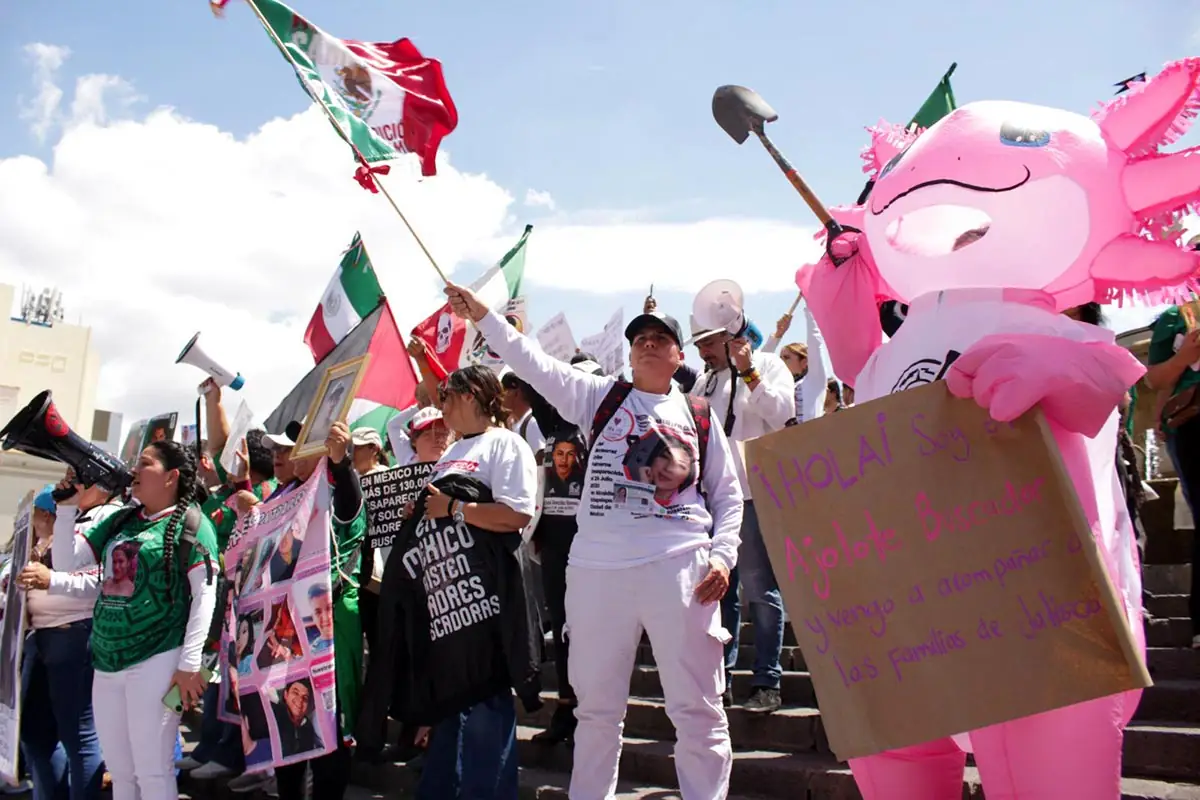
“Today we have around 30 people disappearing per day in the country. Mexico is facing a really deep and ongoing crisis of enforced disappearances,” says Adriana Sánchez, deputy director of programmes at Amnesty International Mexico.
Although the problem exists since the 1960s, the situation has got worse since 2006, when the authorities launched a controversial military offensive against drug cartels, sparking rising violence by criminal gangs and sometimes abuses by State actors.
Mexico’s National Registry of Missing and Disappeared Persons registered more than 116,000 unresolved cases as of 2025, with media reports and human rights experts putting the current number at over 130,000. The real figure may be much higher, and the number continues to grow. Some of the cases date as far back as 1964.
Participation of public officials
“While noting that Mexico’s nationwide ‘war on drugs’ has contributed to the conditions in which such attacks have occurred at the local level, the Committee stressed that it did not find evidence of a federal level policy to commit enforced disappearances,” says the UN Committee on Enforced Disappearances in its April 2, 2026, press release. But it also said it had received “substantiated information pointing to the direct participation of public officials, or their authorisation, support, or acquiescence”.
The Committee has asked the UN Secretary-General to “urgently refer the situation of enforced disappearances in Mexico to the UN General Assembly for consideration of measures to support the State Party in preventing, investigating, punishing and eradicating this crime”. This referral is made under the International Convention for the Protection of All Persons from Enforced Disappearance.
Mostly young victims
“My own case involves the disappearance of my son, Luis Ángel León Rodríguez, on November 16, 2009, in Zitácuaro, Michoacán,” says Araceli Rodríguez, a representative of Colectivo Colibrí which groups relatives of disappeared persons in Mexico. Her son was a federal police officer. He disappeared along with six other officers who were travelling with him and a civilian who was providing security to reach their destination, since the State provided none, she says.
“The issue here is the responsibility of the authorities who sent them on a mission to take over a municipal office in a city without providing them with safe means to reach their destination,” Rodríguez continues. “We have searched in clandestine graves, and as searching mothers, we will continue to search, because we have learned to say, ‘well, if I don’t find my son, I’ll find another woman’s son, and we’ll bring peace to the families’.”
Given the scale of enforced disappearances and the authorities’ perceived slowness and inefficiency in investigating them, many victims’ families have formed their own collectives over the years to search by themselves, with all the risks that may entail for their own safety. “You don’t only have the people who disappear, you also have the people who search for them,” says Sánchez of Amnesty International. “They are threatened, they are killed, they are kidnapped and also become part of the disappeared people.”
Isabel Cruz is founder and president of Sabuesos Guerreras [Warrior Hounds], another civil society organization searching for missing family members. “I lost my son Reyes Yosimar García Cruz, who disappeared on January 26, 2017, here in Culiacán Sinaloa,” she told Justice Info. “I know many women whose children have also disappeared, and we have formed a collective to search with less danger than if we did so alone. In some cases, like mine, our children were disappeared by members of the police and military.”
Cruz says she needs to continue the nine-year search for her son because “if I don’t look for him, no one else will”. “The federal government is doing absolutely nothing,” she adds.
Most perpetrators, according to Amnesty International, are part of organized crime. Sánchez says that as for the victims, “they are sometimes taken away to be part of the gangs, or to be part of human trafficking, organ trafficking”. She says they are frequently people with lower incomes in parts of the cities where organized crime is high, but also in the countryside. It is about 60% men, but also women, although the pattern differs according to different regions of Mexico. The highest number of victims are aged 15-40.
A government “in denial”
Mexican President Claudia Scheinbaum has rejected the UN Committee’s assessment that enforced disappearances in the country amount to crimes against humanity. According to Elena Azaola Garrido, an expert on the issue for the Institute for Integrated Transitions, the Mexican government is also trying to exert diplomatic pressure on other countries to ensure that the UN General Assembly does not vote for a UN intervention.
“They don’t want to recognize the problem,” she says. “They deny it, they say the register is incorrect, that there is not that number of people. But in fact, there are more, because many people feel afraid to go to the authorities, since many times they are responsible for the disappearance. The government says international intervention is an attack on our sovereignty, we are an independent country, and we have the capacity to solve the problem, although at the same time they admit that lack of forensic expertise is a big issue.”
Azaola Garrido, who authored a report on enforced disappearances in Mexico City, thinks the government’s inability to solve the problem stems from both a lack of political will and lack of resources. “This government, I am sorry to say, lies a lot, and covers itself a lot,” she told Justice Info. She says Karla Quintana, former National Commissioner for the Search of Missing Persons in Mexico, was pushed to resign from that post in 2023 because she refused to reduce the numbers of missing on the national register. Quintana now heads the UN’s Independent Institution on Missing Persons in Syria.
Is this a crime against humanity?
The UN committee’s assessment that enforced disappearances in Mexico are crimes against humanity is particularly controversial. Crimes against humanity are defined in international law as “acts committed as part of a widespread or systematic attack against any civilian population, with knowledge of the attack”.
As a crime against humanity, the situation could – at least theoretically – be taken up by the International Criminal Court (ICC). This, says Azaola Garrido, is one of the reasons why the government is so resistant to that qualification, because it could potentially entail senior political figures being indicted by the ICC. She says some of the groups that have lobbied for the UN Committee to refer the Mexican situation to the UN General Assembly have also been fighting for years to get the ICC in The Hague to take up the Mexican situation.
“The answer they have always received in The Hague is that the court is never going to take Mexico,” she continues, “first because it’s a very complex situation: part of the people have been disappeared by government officials, and others by criminal groups. Also, the Mexican government gives money to the court, money to the UN, and these organizations are very political. They have a lot of interests and limitations.”
What the UN could do
But if the General Assembly were to vote assistance to the Mexican government to fight enforced disappearances, would that help? Azaola Garrido thinks UN forensic expertise could be crucial, and the government admits it lacks resources in that area. “At the same time as we have 133,000 people disappeared in Mexico, we have 80,000 people in public forensic graves that have not been identified,” she told Justice Info. “If those corpses were identified, more than half of the problem would be solved.”
She says the UN could help the government to design systems for better communication between local authorities on this issue. “In Mexico, we can have relatively good laws, but they are not implemented,” Azaola Garrido continues. “You should see the situation in prisons, where I have worked for years. There are some people who are considered disappeared, but they are in prison and have not been able to communicate with their families. The authorities are not willing to put in good communications with the families.”
In its decision, the Committee makes a number of recommendations: it asks the UN to take actions aimed at “providing the technical cooperation, financial support, and specialized assistance that Mexico requires in the areas of search operations, forensic analysis, and thorough investigation of allegations of enforced disappearances and links between public officials and organized crime”; and it calls for the UN to “establish an effective mechanism to uncover the truth and provide assistance and protection to families searching for their loved ones, as well as to the organizations and defenders supporting them”. The Committee stresses its commitment to “maintain an ongoing dialogue with the authorities and civil society” and says its application “should not affect, but rather strengthen, cooperation between the Committee and the State Party in question”.
No date is yet known for a General Assembly discussion on Mexico, although it was “urgently” requested by the UN Committee.